

How far is the lodge, really? The road distance to your safari lodge can look straightforward on a map, but a reserve name may not take you to the lodge entrance, and kilometres alone won’t tell you how long the journey will take.
It’s sensible to want a clear estimate before you travel. A useful plan accounts for the exact entrance, route, likely stops and conditions on the day. This article explains how to read road distances, estimate a realistic arrival time and avoid relying on a single map figure.
You’ll also see how to plan a private transfer around your specific lodge destination. Zaf Travel provides private road transfers to safari lodges and game reserves, with the journey organised around where you’re going. Route-specific planning helps make the drive more predictable, from departure through to arrival.
Key Takeaways
- Road distance measures the route travelled, whilst drive time is an estimate affected by journey conditions.
- For a useful safari lodge distance estimate, use the lodge’s exact entrance rather than the reserve name alone.
- Compare route estimates using the same starting point, destination and route mode to make the figures meaningful.
- Plan arrival time with room for stops and changing road conditions, not just the map’s driving estimate.
- A private transfer with Zaf Travel centres the journey on your safari lodge destination and itinerary.
Safari lodge distance: what a road-distance estimate really tells you
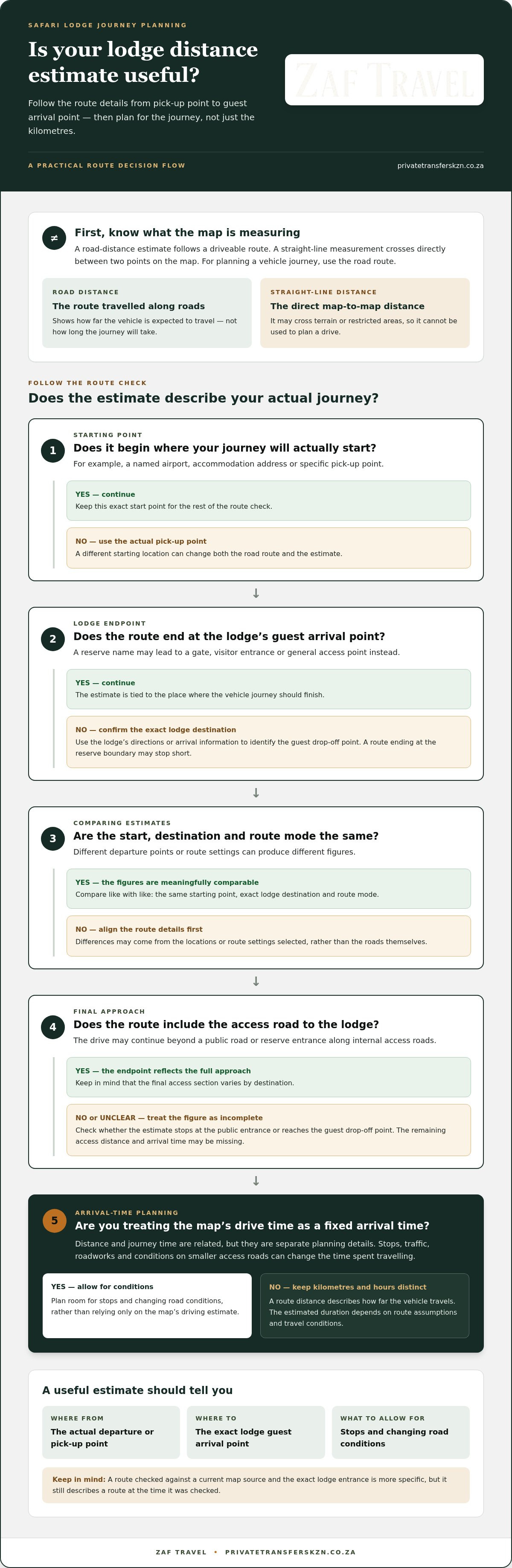
Road distance is the length of a driveable route between a chosen starting point and a specific destination, measured along roads rather than as a direct line. It tells you how far the vehicle is expected to travel, not how long the journey will take. The Durban to safari lodge distance therefore depends on the departure point, route and exact place you’re travelling to.
A map may show both a straight-line measurement and a road route. They answer different questions. The direct line describes the distance between two points across the map; a road-distance estimate follows the available route, which may bend around terrain, connect through junctions or use a longer road network. The driveable route is the relevant figure for planning a vehicle journey.
Road distance versus straight-line distance
Simple example, not a route measurement: imagine a lodge appears close to your starting point on a map, but a river or restricted area lies between them. The straight-line distance crosses the map directly. The road route must follow roads to a usable crossing, so the vehicle travels a different distance. This is why a map’s direct-line figure can’t be used to plan a drive.
Even two road estimates can differ if they use different departure points or route settings. One might begin at an airport, another at an accommodation address; one may follow a main road, whilst another selects a different connection. Before comparing figures, make sure they describe the same journey. General Driving in South Africa guidance can help with wider road-planning context, but it doesn’t replace checking the route to your particular destination.
Distance doesn’t determine arrival time on its own. A journey-time estimate uses assumptions about the route and travel conditions. Stops, traffic, roadworks and conditions along smaller access roads can change the time spent travelling, even if the route distance stays the same. Treat kilometres and hours as related but separate planning details.
Why a reserve name may not be the final endpoint
A reserve entrance and a lodge are not necessarily the same destination. A map search using only the reserve name may guide you to a gate, visitor entrance or general access point. Your actual drop-off may be elsewhere, including along internal roads beyond that entrance.
That distinction matters. If a route ends at the reserve boundary, its distance and estimated time may not include the final drive to the lodge or guest drop-off point. For a more useful estimate, use the exact lodge destination rather than relying on the reserve label alone. Confirm that the map pin represents where your vehicle journey should finish.
For transfer planning, give the endpoint the same attention as the departure point. A precise destination helps keep the route estimate relevant to your itinerary and reduces the risk of planning around a figure that stops short of the place you’re actually going.
Why the exact lodge entrance changes the safari drive estimate
A route estimate is only as useful as its start and finish points. A broad area label can produce a route from the wrong side of that area, whilst a reserve name may direct the map to a public gate rather than the lodge where guests arrive. The resulting kilometres and drive-time estimate may not match the journey you need to plan.
The more precisely you identify the departure point and lodge arrival point, the more relevant the route estimate will be. This matters when researching the Durban to safari lodge distance: a figure attached to a general destination label shouldn’t be treated as a measurement to every lodge within that area.
Choose a precise starting point and destination
Start with where the journey will actually begin, such as a named airport, accommodation address or other specific pick-up point. Then enter the lodge’s guest arrival point, not just the reserve name. If the route planner can’t locate that point, use the lodge’s directions or arrival information to identify the correct destination before relying on its result.
A vague endpoint can stop the route at a reserve gate or a general map pin. That may be useful for orientation, but it isn’t necessarily the distance to the lodge itself. Keep the same start and end points when comparing route results; otherwise, differences between figures may come from the selected locations rather than the roads.
Account for the final approach to the lodge
Consider the main-road portion and the final access section separately. After leaving a public road, the route may continue along access roads within a reserve before reaching the lodge. The length and character of that approach vary by destination, so don’t assume that all reserve entrances or final stretches are alike.
Check whether a route estimate ends at the public entrance or the lodge’s guest drop-off point. A map result that stops at the entrance may omit the remaining access distance. It may also give an incomplete picture of arrival time if the final approach is not represented accurately.
When reviewing any published figure, note what it measures. A route distance checked against a current map source and the exact lodge entrance is more specific than a general estimate, but it still describes a route at the time it was checked. Traffic, temporary road changes and other travel conditions can affect journey time. Treat a figure without a named endpoint or a clear route source as indicative, not as a precise door-to-door measurement.
Travelling independently? The Official South African Driving Information page provides government guidance on driving-related matters. For a journey planned around a specific lodge arrival point, a private safari lodge transfer offers a direct passenger-transport option.
How to compare safari lodge distances and estimated driving times
Route distance measures how far the vehicle travels along roads; estimated driving time predicts how long that route may take. Keep the figures separate. A shorter route isn’t automatically quicker, and a longer route may have different road or traffic conditions.
For a meaningful comparison, use the same departure point, lodge arrival point and route mode each time. This is especially useful when comparing options after searching for a safari lodge distance. If one result starts at a general area and another at your actual pick-up point, their figures don’t describe the same journey.
A simple method for checking a route estimate
- Set the start. Enter the actual pick-up address or named departure point, rather than a broad area label.
- Set the finish. Use the lodge’s guest arrival point. A reserve name alone may lead to a gate or general map pin.
- Select a road journey. Check that the result is for driving, not a direct-line measurement or another travel mode.
- Record the figures separately. Note the route distance and estimated driving time, along with the route source and when you checked it.
This gives you a clear basis for comparison. If you look at more than one route option, keep the same start and finish points and compare the alternatives within the same driving mode. A change in distance or duration may reflect a different route, so note which one the estimate follows.
Read journey-time estimates with care
A map duration is an estimate, not a promised arrival time. It can be affected by traffic, stops and current road conditions. The route result may also change when a navigation service updates its information or selects a different road. Use it as a planning reference, not as a fixed appointment time.
Build the journey into the day’s itinerary rather than planning around one map figure alone. Consider when you need to arrive, whether the journey includes planned stops, and whether road conditions could change. Don’t add an arbitrary buffer and present it as a reliable rule; the appropriate allowance depends on the route and travel plans.
For independent travel planning, the South Africa Travel Safety and Advisories page provides wider country travel guidance. It’s separate from a route planner, so use it alongside current route information rather than as a substitute for checking the drive.
If you’d prefer passenger transport organised around your lodge destination and itinerary, a private safari lodge transfer is another way to plan the road journey without relying on a shared schedule.
Plan your safari lodge journey around distance, timing and arrival
A realistic journey plan connects three details: where you’ll leave from, where you need to arrive and how long the road journey may take. Keep these details together. A distance estimate on its own won’t tell you whether your schedule allows for stops or fits the lodge’s arrival arrangements.
Use this checklist to organise the travel day:
- Departure point: record the actual pick-up address or meeting point.
- Lodge endpoint: use the guest arrival or drop-off point, not just a reserve label.
- Road estimate: note the current route distance and estimated driving time separately.
- Journey factors: account for planned stops and the possibility of changing conditions.
- Arrival details: keep the lodge’s arrival time or instructions alongside the route information.
Set a realistic departure and arrival plan
Start with the time you intend to reach the lodge, then work backwards using the estimated journey duration as a guide. Include the stops you expect to make, but don’t rely on a universal allowance: the right amount of flexibility depends on your itinerary and the journey. The map estimate describes driving, not every part of the travel day.
Keep arrival coordination separate. A lodge’s requested arrival time or guest handover arrangement is not included in the road-distance figure. Check that your planned departure gives you a sensible route to that arrival point, rather than treating the estimated drive time as a guaranteed arrival time.
Keep route information consistent
If you review the route again, use the same departure and lodge arrival points so the updated estimate remains comparable. Recheck close to travel if conditions may have changed, and make sure everyone travelling has the same current itinerary. That reduces confusion if someone else needs to follow the route or coordinate the arrival.
Keep the key details accessible together: the route, destination pin, planned stops and lodge arrival information. If the journey is arranged as a private transfer, share the itinerary details consistently so the passenger journey is centred on the intended pick-up and drop-off points.
A little coordination makes the mileage figure more useful. It connects the road estimate to the actual travel day, including the point where the journey begins and the place where guests are expected. Review the plan as a whole, not just the number of kilometres or the map’s predicted duration.
Plan your lodge journey with a private safari lodge transfer built around your destination and itinerary.
Arrange a private safari lodge transfer with distance in mind
Once you’ve identified the road route and a realistic journey duration, you can decide how to organise the passenger journey. Zaf Travel provides private road transfers to safari lodges and game reserves. This transport option is for travellers who want the journey planned around their own pick-up point, destination and itinerary.
The search phrase “Durban to safari lodge distance” may help you begin your research, but a useful transfer plan needs more than a general distance figure. The exact departure point, lodge arrival point and estimated drive duration all help define the journey. Keep those details together when organising transport.
When a dedicated road transfer fits the itinerary
A private transfer can suit travellers seeking direct road transport to a lodge, particularly when the journey is one part of a wider travel schedule. Instead of treating the reserve name as the whole plan, use the specific lodge destination and intended arrival time to frame the drive.
This keeps the arrangement focused on getting passengers to the planned destination. It doesn’t depend on assumptions about lodge activities or accommodation arrangements. The relevant details are practical: where the journey starts, where guests need to be dropped off, and how the estimated drive fits the day.
Move from distance research to a transfer plan
Before arranging the journey, bring the key route details into one clear itinerary:
- Departure point: the precise pick-up location, rather than a broad area.
- Lodge endpoint: the guest arrival or drop-off point, not only the reserve name.
- Journey estimate: the current road distance and estimated driving time, kept as separate figures.
- Arrival plan: the intended arrival time and any relevant lodge instructions.
Use the estimated duration as a planning reference, not a guaranteed arrival time. Stops and changing travel conditions can affect the actual journey. Organise the transfer around the arrival you have planned, while keeping the route details consistent so the pick-up and destination are clear.
A well-defined itinerary gives the transfer a practical starting point: the passenger journey is centred on the traveller’s route and lodge destination. If you’re ready to organise road transport for your safari stay, explore Zaf Travel’s private safari lodge transfers.
Make your safari arrival part of the plan
Use your route research to shape a travel day that works with the rest of your itinerary. The Durban to safari lodge distance is a starting point, not the whole plan: your departure details, arrival arrangements and preferred way of travelling all matter. Once those pieces fit together, you can move ahead with greater clarity.
Zaf Travel specialises in private road transfers to safari lodges and game reserves. The passenger transport is dedicated to your journey rather than shared with other travellers, keeping the focus on your own itinerary and destination.
Ready to plan the road journey? Explore private safari lodge transfers with Zaf Travel and take the next step towards a well-organised arrival.
Frequently Asked Questions
How far away is a safari lodge by road?
There’s no single road distance for a safari lodge; it depends on the departure point, chosen route and exact lodge destination. Even lodges within the same reserve may require different drives if their guest arrival points are in different places. For a useful route estimate, use the precise pick-up location and lodge endpoint rather than treating a reserve name as a complete route. Recheck the estimate if either point changes.
How long does it take to drive to a safari lodge?
Drive time depends on the route and conditions during your journey, so there isn’t one duration that applies to every lodge. A navigation estimate can help you plan, but it may not include stops or reflect later changes to traffic and roads. For example, if you’re collecting passengers or taking a break, include that in your own schedule. Keep the map’s predicted driving time separate from the time you allow for the full trip.
Is road distance the same as the distance shown on a map?
Not always, because a map can show a direct measurement between two points as well as a distance along roads. The direct measurement doesn’t describe how a vehicle can travel. Check that the map is set to driving and displays a route between your chosen start and finish. If you switch between map views or travel modes, the figures may no longer describe the same journey.
Can a lodge’s reserve entrance be different from its guest arrival point?
Yes. A route to a reserve entrance may finish before the road reaches the lodge’s guest arrival or drop-off point. This can matter if you’re arranging a pick-up or planning to arrive at a particular time. Use the lodge’s guest directions to identify the intended endpoint, and save that location with your itinerary. A pin for the reserve alone may guide you to a general entrance rather than your final destination.
What affects the estimated driving time to a safari lodge?
Traffic, stops and current road conditions can all affect how long the drive takes. The route selected by a navigation service may also change, which can alter the predicted duration. If the journey includes a meal break, passenger collection or another planned stop, account for it separately. Checking the route close to departure can help you notice changes, but no map estimate can promise an exact arrival time.
Should I plan my transfer using distance or journey time?
Use both, because each helps with a different part of the plan. Road distance describes the route travelled, while estimated journey time helps you consider how the drive fits your schedule. For example, the distance can help you compare route options, and the time estimate can inform when to leave. Add your planned stops and lodge arrival arrangements to the itinerary rather than treating either map figure as the whole travel plan.
Can I arrange a private road transfer to a safari lodge?
Yes. Zaf Travel specialises in private road transfers to safari lodges and game reserves. The service is dedicated passenger transport, rather than a shared shuttle, and can form part of a journey planned around your itinerary. Have your departure point, exact lodge arrival destination and preferred arrival time ready when organising the trip. This gives the transfer plan clear endpoints and connects it to the journey you intend to make.
